

PANEL CYBERSECURITY AUTONOMOUS SHIPPING
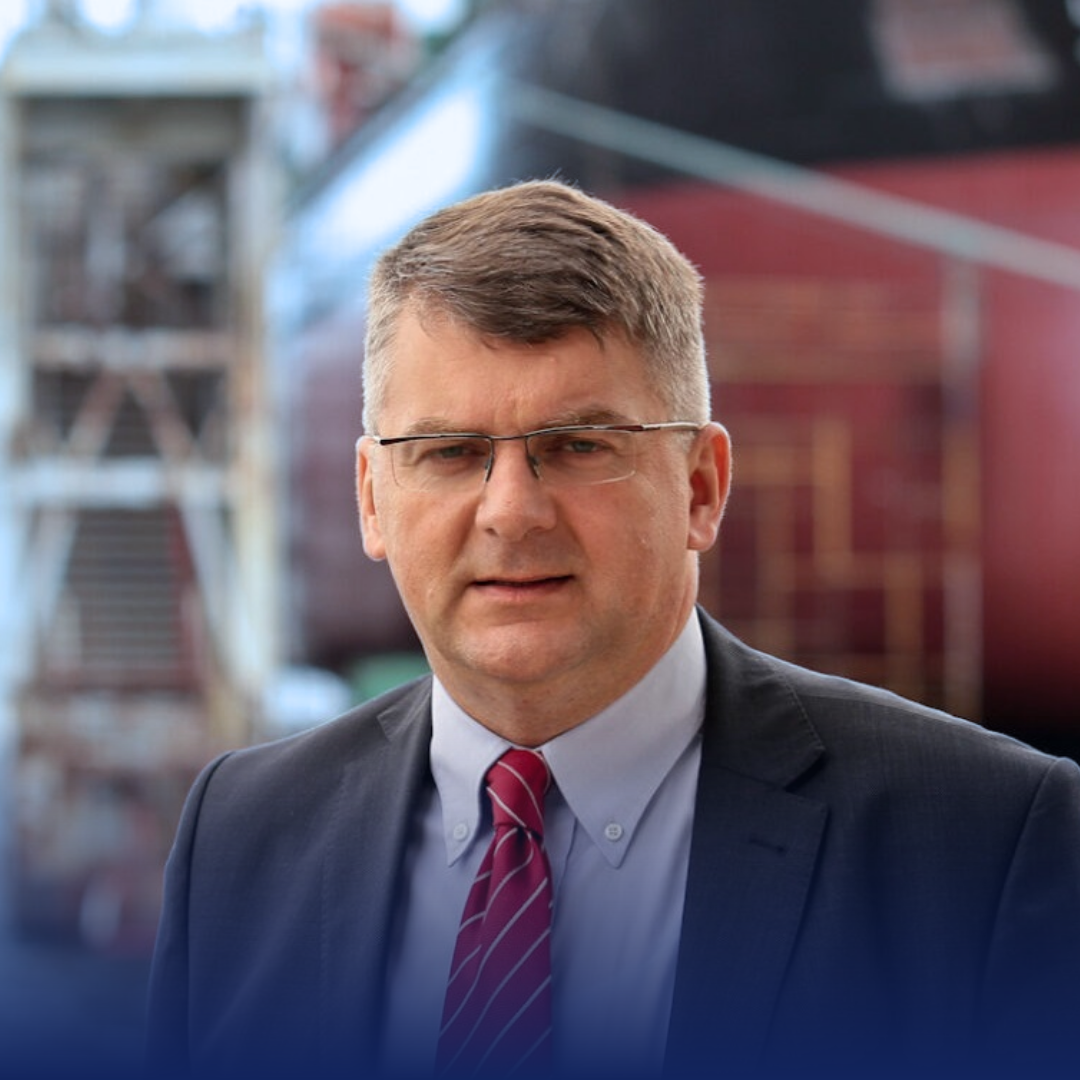
Leder Rafał Cichocki
Head of the UMG Maritime Cyber Security Center
Polish Shipbuilding Sector on the Wave of Global Growth – The Future Belongs to Innovators
ter years of a deep downturn, the shipbuilding industry has entered a phase of powerful cyclical recovery. The global shipbuilding orderbook is growing rapidly, while production capacity in many locations is booked several years in advance. The current shipbuilding upturn is not driven by a single factor, but rather by the convergence of several powerful market, technological and geopolitical trends.
Asian shipyards are the primary beneficiaries of this upturn, but European shipyards, including those in Poland, are also benefiting. Some Polish shipyards already have orderbooks filled several years ahead.
We are at a turning point: decarbonization and digitalization – including the development of Artificial Intelligence – are accelerating and will transform the maritime sector in the years ahead. We also face challenges related to our security and the necessary expansion of defense production.
Europe is moving towards strengthening its leading global position in the design and construction of technologically advanced vessels. The Polish shipbuilding industry also has significant strengths, but it faces challenges that must be addressed. One of these is the growing shortage of qualified personnel.
The panel participants will jointly seek answers to the question: How can we effectively capitalize on the current market upturn and build a strong global brand for the Polish shipbuilding industry?
The discussion will focus on the strategic directions for the development of the Polish shipbuilding industry amid the global recovery of the shipbuilding sector. The main objective will be to identify a pathway and develop a model enabling many Polish companies to transition from the role of subcontractors to becoming suppliers of technologically advanced shipbuilding products and services with high added value.
The future belongs to innovators.
Panelists
- Honorata Hencel – Managing Director, Boeing in Poland and Ukraine
Responsible for integrating commercial and defense operations and maintaining government relations. With over 20 years of experience in aviation and technology, she previously led IT services for 8,000 employees across Europe. Co-founder of Aviation Hub Pomerania, Chair of Boeing Women Inspiring Leadership Europe, and recipient of the 2024 Distinguished Global Leader Award. - Thierry Coq – Senior Principal Consultant, Cyber Safety & Security, DNV Accelerator
Cybersecurity and critical systems specialist. Focuses on integrating safety into industrial system and software design, particularly in the maritime infrastructure sector. Has expertise in risk management, reliability, and cyber engineering. - Dr. Jarosław Cydejko – PhD Eng., Master Mariner, Maritime University in Gdynia
Assistant Professor at the Faculty of Navigation, Maritime University in Gdynia. Specializes in GPS signal interference and satellite navigation in the Baltic Sea region; conducts research on jamming and spoofing. Actively involved in identifying geolocation signal interference sources and analyzing their impact on maritime navigation and communication. - Grzegorz Trzeciak – SQUADRON Sp. z o.o., former Commander of the Unmanned Aerial Vehicle Squadron
Former commander of a reconnaissance UAV squadron. At SQUADRON, he played a key role in the development of UAV technology and anti-drone systems, including as Director of the Unmanned Technologies Center. - Krzysztof Walczak – Head of Cybersecurity and IT Compliance Department, Acting Director of the Security Management Department
- Wojciech Zdanowicz – Director, Maritime Office in Szczecin
Graduate of the Maritime University of Szczecin and John Moores University in Liverpool, with a Master’s degree in navigation and maritime rescue. He has also completed postgraduate studies in computer science, project management, and MBA programs. Member of the SAR Council and Chairman of the Administrative Board of EMSA. - Anna Białkowska – Deputy Director of the Maritime Office in Gdynia for Maritime Inspections
Represents the Maritime Office in Gdynia in matters related to MASS systems and the development of autonomous ships. Coordinates maritime inspections and oversees the safety of ports, vessels, and Polish seafarers. Represents Poland at ILO and IMO sessions. A graduate of the Maritime University in Gdynia, she has been working in maritime administration for over 20 years. - Wojciech Kozyro – Head of the Technical Service Division, Ship Division, Polish Register of Shipping (PRS)
National Coordinator for Maritime Autonomous Surface Ships (MASS) and member of the IACS Safety Panel. Actively involved in the development of international regulations for autonomous shipping. As Head of the Technical Service Division of PRS, he is responsible for supervision of ship construction and operation. Represents Poland in the work of the IMO, EU RO MR Group, and other maritime regulatory bodies.
INFORMATION ABOUT THE PANEL LEADER
Rafał Cichocki, CISSP, CEH Head of the Center for Maritime Cyber Security at Gdynia Maritime University.
Cyber security specialist and practitioner with more than two decades of experience. Entrepreneur, university lecturer, certified trainer in Certified Ethical Hacker (CEI EC-COUNCIL), and Palo Alto Networks Cybersecurity Academy. Creator of lectures, labs and training courses on cyber security, including Cyber Range (networks, web applications, email security, OC security) and computer networks. Social activist for local communities.